The Breed
American Cocker Spaniel Temperament: A Practical Guide
“Merry” describes the American Cocker Spaniel's written ideal, not a guarantee attached to every puppy. Sound decisions begin by combining breed context with the individual dog's history, health, learning and behavior in the situation in front of you.
A standard describes qualities breeders and judges aim for. It cannot forecast whether one dog will welcome a child, live calmly with a cat, cope with solitude or feel safe in a particular setting. Observe the individual, manage risk and treat behavior change as information rather than a moral failing.
The standard and the individual#
The American Spaniel Club breed standard asks for an equable temperament without timidity and describes the Cocker as merry and affectionate. Those words define a desirable presentation for the breed. They do not mean that fear, frustration, guarding, aggression or withdrawal is impossible. The American Veterinary Society of Animal Behavior is explicit that breed alone does not predict aggressive behavior and that dogs must be evaluated individually.
The AKC breed profile supplies broad trait tendencies, such as playfulness and trainability, but even its ratings are framed as likelihoods. Within this breed, people may meet exuberant greeters, thoughtful observers, energetic sporting partners and quieter home companions. Behavior can also differ across places: a dog relaxed at home may be cautious in a clinic, busy street or crowded class. Ask what happened, where, with whom and how quickly the dog recovered instead of assigning a permanent label from one encounter.

How temperament develops#
Adult behavior emerges from interacting influences: inherited tendencies, prenatal and early care, maternal and litter experience, physical health, social exposure, learning, maturation and current environment. No single influence writes the entire outcome. A breeder can reduce uncertainty by selecting stable parents, raising puppies in a clean and varied home environment and matching them thoughtfully, but cannot promise an exact adult personality. An adult rescue's foster observations may be especially useful, yet a move can temporarily change appetite, sleep, activity and social behavior.
Socialization means creating safe, positive, choice-rich experiences, not forcing a puppy to endure everything. The AVSAB puppy-socialization statement identifies the first three months as especially important and supports well-run classes before the vaccine series is complete when disease precautions are appropriate. Ask your veterinarian about local infectious-disease risk and suitable settings. Pair new surfaces, sounds, people, gentle handling and travel with food, play or space; stop if the puppy withdraws or cannot recover. Quality matters more than collecting a large number of encounters.
Development continues after puppyhood. Adolescence can bring changing attention, arousal and social responses; aging, pain or sensory loss can change them again. The AAHA guidance on age and behavior recommends monitoring recoverability and emerging fears rather than assuming every change is a phase. Keep brief notes on triggers, distance, duration and recovery. Patterns are more useful to a veterinarian or behavior professional than descriptions such as “stubborn” or “dominant.”
Education without coercion#
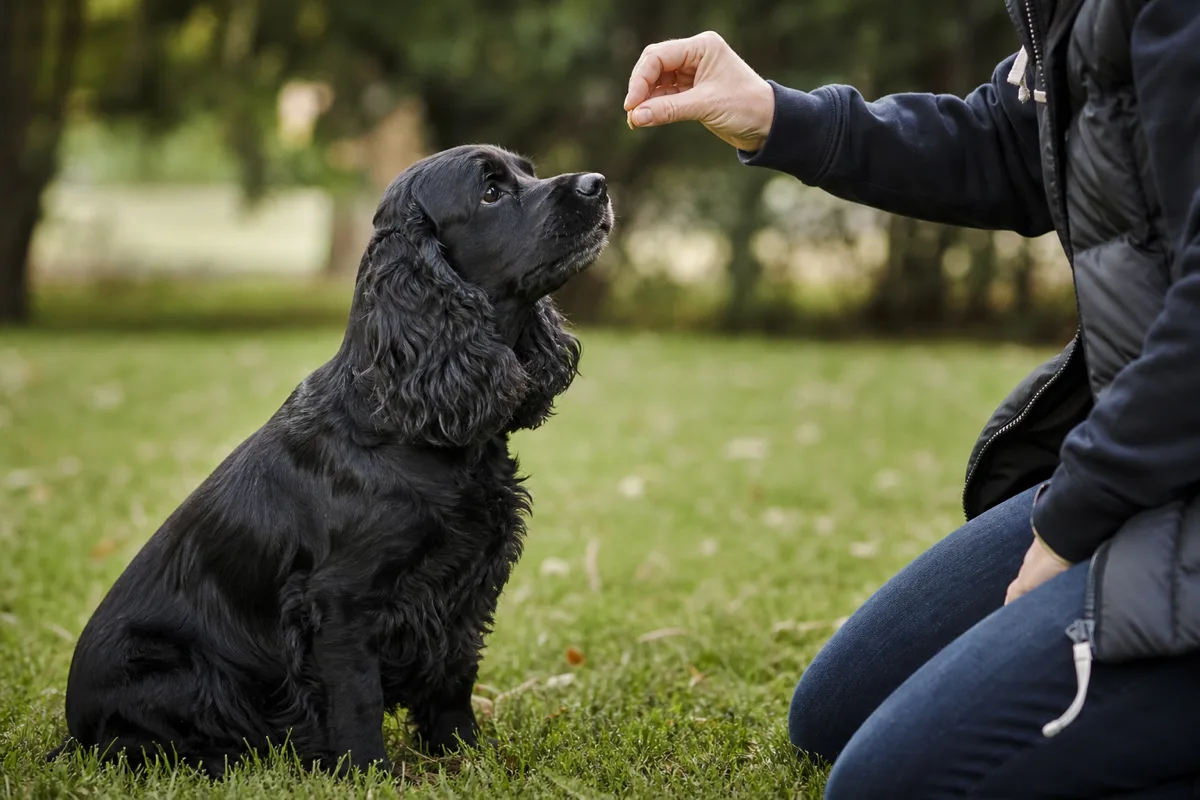
Good education makes daily life predictable. Reinforce behaviors you want—checking in, settling on a mat, releasing an object, coming when called and standing for care—with rewards the dog values. Arrange the environment so the learner can succeed, keep sessions brief, and increase only one difficulty at a time. A cue is not proof that a dog can perform everywhere; distance, duration and distraction must be taught gradually.
The current AVSAB humane-training position recommends reward-based methods for training and behavior modification and advises against aversive tools and physical or psychological punishment. Corrections may suppress a warning without changing the fear or conflict beneath it. Never punish growling: create distance, prevent another unsafe rehearsal and get qualified help. Promises of a guaranteed cure, instant obedience or a dog that will never make a mistake are reasons to walk away from a provider.
Activity, enrichment and rest#
The American Cocker is a sporting dog in a compact body, but there is no evidence-based daily minute quota that fits every individual. Build a balanced routine from walks, sniffing, play, retrieving, food-search games, short training and opportunities to rest undisturbed. Adjust for age, conditioning, weather and health. A puppy needs exploration without adult endurance work; a dog with pain, breathing change, unusual fatigue or altered gait needs veterinary guidance before activity increases.
More intensity is not always the answer to restlessness. Repeated high-arousal games can produce a highly practiced athlete who still has not learned to settle. Alternate active outings with decompression, chewing or quiet station work. Cooperative grooming is enrichment with a practical purpose for this heavily feathered breed: teach chin rests, paw handling, ear checks and brief combing in exchange for rewards. The detailed grooming guide explains the physical routine.

Children, visitors and shared space#
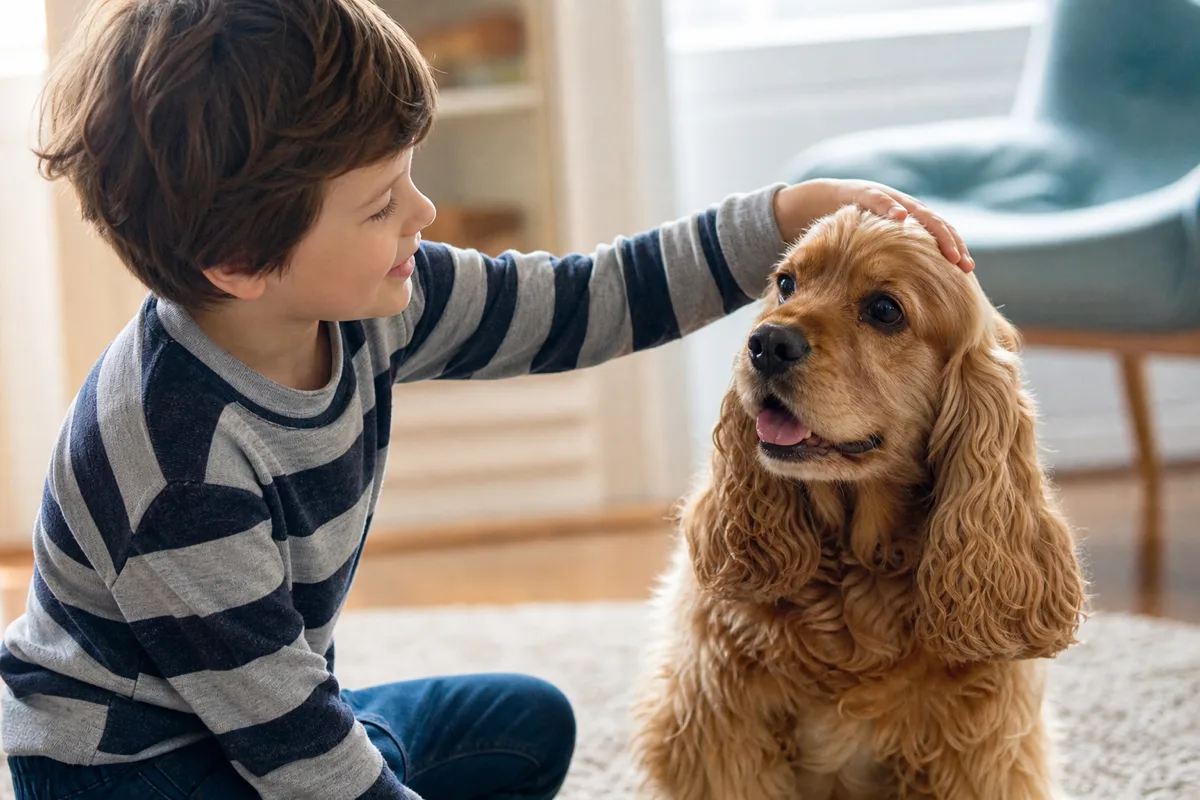
No breed label makes child–dog interaction automatically safe. The AVMA dog-bite prevention guidance says young children should always be supervised with dogs. Active supervision means an adult is close, attentive and ready to intervene—not watching from another room. Use gates or separate rooms when that is impossible. Give the dog a child-free resting place, and teach children not to climb on, hug, corner or disturb a dog who is eating, chewing or sleeping.
Introductions should preserve choice. Let the dog approach rather than being carried toward a visitor; reward calm observation; end the interaction when either party needs a break. A wagging tail alone does not certify friendliness. Look at the whole body and its movement. Freezing, turning away, retreating, a closed tense mouth or escalating vocalization means increase distance. If there has been a snap or bite, prevent repeat access and seek professional assessment rather than testing tolerance again.
Dogs, cats and smaller animals#
Compatibility with another animal depends on both individuals, their histories, resources and introduction plan. Begin dog meetings in neutral, spacious surroundings with skilled handlers and avoid tight face-to-face restraint. For cats, use barriers, high escape routes and separate resources; prevent chasing from the first day. Birds and small mammals require secure separation because spaniel heritage does not reveal the strength of one dog's interest or guarantee inhibition. Peaceful living cannot be promised, and some pairings are not safe.

Alone time without assumptions#
Following people around does not by itself diagnose separation anxiety, and neither barking nor damage has one universal cause. Build comfortable independence early: offer rest behind a gate while someone remains nearby, then practise very short departures and return before distress begins. A camera can show whether the dog settles, scans, paces or vocalizes. Increase duration according to the dog's response, not a calendar. Food toys can help a relaxed dog but are not a cure, and confinement may intensify distress in some dogs.
The Merck Veterinary Manual behavior overview explains that separation-related signs can overlap with incomplete housetraining, external triggers, noise fear and confinement distress. Diagnosis requires history and exclusion of medical contributors. If the dog repeatedly panics, tries to escape, injures itself, soils despite being house-trained or cannot eat when alone, pause unsupported duration increases and contact a veterinarian. Temporary dog care may be part of risk management while a plan is developed.
Read stress before it escalates#
Stress signals are context-dependent and should be read in clusters. The AAHA anxiety and distress table includes panting, trembling, lip licking, yawning, freezing, pacing, hiding, escape attempts, lowered posture, turning away and changes in closeness or appetite. Some also occur during heat, exertion or illness; a single yawn is not a diagnosis. Notice what precedes the change and whether distance helps.
Respond by reducing pressure: stop reaching, move people or animals away, provide a barrier and let the dog recover. Do not lure a frightened dog closer only to trap it, and do not keep exposing the dog until it “gets used to it.” Sudden behavior change, new irritability, handling sensitivity, sleep disruption or loss of learned skills warrants veterinary consultation because pain, sensory change and other medical conditions can affect behavior.
When and where to seek qualified help#
Start with a veterinarian for a new or escalating change, suspected pain, self-injury, house-soiling, confusion, sleep change, loss of appetite or any behavior severe enough to compromise welfare. The Merck diagnostic guidance emphasizes history, physical and neurologic examination and indicated testing before a behavioral diagnosis. Bring video only when it can be recorded safely, plus a log of antecedent, behavior, consequence, duration and recovery.
For aggression, intense fear, repeated panic or a complex multi-pet case, ask about referral. The American College of Veterinary Behaviorists directory lists board-certified veterinary specialists. A skilled non-veterinary consultant can support training and environmental change while coordinating with the veterinarian; the IAABC credential guide explains assessed credentials. Interview any provider about education, continuing development, methods, safety planning, veterinary collaboration and scope. Only a veterinarian diagnoses medical conditions or prescribes medication.
A responsible compatibility decision#
Choose an American Cocker for the care you can provide, not for a promised personality. Can the household fund coat care and veterinary care, supervise children, separate animals, teach alone time gradually and supply daily activity plus rest? Is everyone willing to use humane methods? Meet adults related to a prospective puppy when possible, verify health records, and ask the breeder how puppies are raised and matched. The breeder evaluation guide provides a practical checklist.
For an adult, ask the rescue or current caregiver what was directly observed, in which setting, and what remains unknown. Request details about handling, visitors, dogs, cats, children, confinement and departures without treating a single shelter test as destiny. A responsible source discloses uncertainty, discusses support and offers a return pathway. The right decision may be this breed, a particular adult, a different dog or no dog yet.
Frequently asked questions#
Are American Cocker Spaniels always friendly?
No. “Merry,” affectionate and equable describe the breed standard's ideal, not every individual's behavior in every context. Genetics, development, learning, health and environment all contribute. Observe the actual dog, respect avoidance and manage introductions. Fear or aggression should never be dismissed because it seems inconsistent with the breed.
Are American Cocker Spaniels good with children?
Some individuals live very comfortably with children, but breed and size cannot guarantee safety. Young children need active adult supervision around every dog, and the dog needs a protected resting place. Teach children to avoid hugging, climbing on or disturbing the dog. Use physical separation whenever close supervision is unavailable.
What is the best way to socialize an American Cocker puppy?
Offer varied, safe experiences at an intensity the puppy can handle while pairing them with food, play, choice and distance. Do not force contact or flood a frightened puppy. Discuss local infection risk and suitable classes with your veterinarian. Continue positive exposure beyond the early sensitive period and seek help if fear persists.
How much exercise does an American Cocker Spaniel need?
There is no universal minute target. Combine daily movement with sniffing, play, reward-based education, food-search activities and undisturbed rest, then adjust for age, conditioning, weather, health and recovery. Sudden reluctance, unusual fatigue, coughing, breathing change or altered gait needs veterinary guidance rather than a harder exercise plan.
Does following me everywhere mean separation anxiety?
No. Proximity-seeking alone is not diagnostic. Use a camera to observe what happens after departure and note pacing, vocalization, escape attempts, elimination, inability to eat and failure to settle. These signs have several possible causes. Repeated distress or self-injury calls for veterinary assessment and an individualized behavior plan.
When should I consult a veterinarian or behavior professional?
Contact a veterinarian for sudden or escalating behavior change, suspected pain, confusion, sleep or appetite change, self-injury, panic or aggression. Ask about a board-certified veterinary behaviorist for severe or complex cases. A credentialed reward-based consultant can help implement skills and management while respecting veterinary scope and coordinating care.
Sources and further reading#
- American Spaniel Club: Cocker Spaniel Breed Standard
- American Kennel Club: Cocker Spaniel Breed Profile
- AVSAB: Breed-Specific Legislation Position Statement
- AVSAB: Puppy Socialization Position Statement
- AVSAB: Humane Dog Training Position Statement
- AAHA: Age and Behavior
- AAHA: Common Signs of Anxiety and Distress
- AVMA: Dog Bite Prevention
- Merck Veterinary Manual: Behavior Problems of Dogs
- Merck Veterinary Manual: Diagnosis of Behavior Problems in Animals
- American College of Veterinary Behaviorists: Find a Diplomate
- IAABC: Professional Credentials